
Printed Green Book vs App
The decision is not “paper is old, phone is new.” Under USGA Rule 4.3, a putting-green map has the same job whether it is ink or pixels: it may show slope at a legal scale, and it may not take the read away from the player. A printed StrackaLine greens guide is built to that paper size and scale from the start. A phone can hold a legal map only if the image on the screen still meets those limits — and only if you do not use the device in a way the rule was written to stop.
Jim Stracka invented the laser-scanned green-reading map in 2007. The same scan can print in a book or appear in a digital product. The rules do not care which screen you prefer. They care about scale, size, magnification, and whether the tool produces a recommended line of play from the ball. The full interpretation is on What’s Legal? – USGA Rules and at usga.org/GRM.
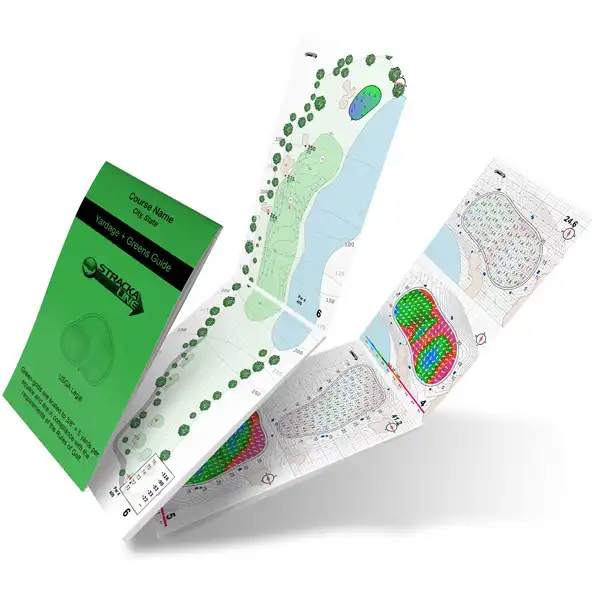
A printed USGA greens guide is already at legal scale and 4 1/4 × 7 inch paper size.
What the printed book is
A StrackaLine USGA greens guide is a physical book. Green images are scaled no larger than 3/8 inch to 5 yards (1:480). The book itself is no larger than 4 1/4 × 7 inches. Dual-view topographic slope is printed in percent, accurate to the millimeter, with a 1-yard / 5-yard grid and surrounding hazards and sprinkler heads for orientation. You turn the page. You do not pinch-zoom the green.
That last sentence is the practical reason many golfers carry paper in a competition. The book cannot enlarge the green past the scale limit because the ink is already printed at that scale. Prescription glasses are allowed. A magnifying glass, a camera zoom, or any other enlargement of putting-green information is not. Handwritten notes you or your caddie add still have to live on paper that meets the size limit.
StrackaLine currently only offers the USGA legal version of the greens guide. A previous Practice version did not meet the scale requirement. If you are learning the page itself, use How to Read a Green Book and the how-to video.
What a phone map still has to obey
In electronic or digital form, any image of a putting green must meet the same scale and size limits as paper. Meeting those limits is not the end of the rule. You are still in breach of Rule 4.3 if you use the device in a manner not consistent with the purpose of the limits, including:
- Increasing the size of the green’s representation beyond the scale or size limits
- Producing a recommended line of play based on the location, or estimated location, of the ball (see Rule 4.3a(1))
Those two bullets are why “I have the map on my phone” is not automatically legal. Zooming a green past 3/8 inch to 5 yards is the digital version of printing an oversized image. A feature that draws a start line from where the ball sits is the digital version of taking the read away from the player. Slope in percent on a legal-size image is allowed. A recommended line from ball location is not.
The same dual-view topo, grid, and orientation marks that appear in the printed book are the legal content. How to read the percent and the fall line without treating the map as an aim-bot is on How to Read Green Heat Maps.
Tournament paper versus a phone in the bag
If the round is a competition that applies Rule 4.3, treat the phone as a map viewer that must stay inside the same box as the book — not as a larger, zoomable green. If you are not sure the digital image will stay at legal scale on that screen, the printed USGA book is the version that cannot accidentally zoom. Committees can also set their own device policies on top of the Rules of Golf. The book does not need a battery, a signal, or a brightness setting on a sunny green.
A yardage book is a different page. Tee-to-green numbers, elevation, cover to bunkers and penalty areas, distance rings, and compass are hole-management tools. They do not replace a greens guide, and a greens guide does not replace them. Combo books bind both at legal paper size. That split is on Yardage Book vs Green Reading Book.
Checkout for books and digital access is on StrackaLine.com, not on strackagolf.com. Search the course, then see whether a greens guide, yardage book, combo, or digital option is listed. The database holds 31K+ courses; 13,000+ have full hyper-accurate green data. How to Order a Yardage Book is the walkthrough.
Search books and digital options Read the USGA limits
What this page is not comparing
This is not a GPS-watch roundup. A rangefinder or shot-tracking device that does not display a putting-green map at illegal scale is a different product conversation. The question here is only whether the green image you use to read a putt is a legal printed book or a legal digital image — and whether you are using either one as a map or as a recommended line.
Facilities that want printed books in the shop use wholesale book pricing and StrackaLine facilities. College programs sit on the NCAA program page. Other guides are listed on Resources.
FAQ
Is a phone green map legal if the book is legal?
Only if the digital image still meets the scale and size limits, you do not enlarge the green past those limits, and the device does not produce a recommended line of play from the ball. Legal paper does not automatically make every phone view legal.
Can I zoom the green on my phone during a round?
No. Increasing the green’s representation beyond 3/8 inch to 5 yards (or beyond the size limit) is a breach of Rule 4.3, even when the underlying file was built to legal scale.
Can the app draw a line from my ball to the hole?
No. Producing a recommended line of play based on ball location is called out in the electronic-map interpretation of Rule 4.3. The map may show slope. You pick the aim.
Why carry a printed book at all?
The printed USGA greens guide is already at legal scale and paper size. It cannot pinch-zoom, and it does not depend on a screen. Many golfers still keep a phone for other uses and keep the book for the putting green.