
How to Read a Green Book
A StrackaLine greens guide is a printed map of the putting surface. It shows slope. It does not pick your line. Jim Stracka invented the laser-scanned green-reading map in 2007, working as a father-and-son team, and the same mapping method is what you open when you use a USGA-compliant StrackaLine book today. More than two million physical books have been sold from that work.
This page is the written companion to the existing walkthrough. If you want the on-screen version, watch How to Read a Green Book (video). The scale, paper size, handwritten-note, and digital-map limits that make a book legal in a competition are on What’s Legal? – USGA Rules, with the USGA’s own material at usga.org/GRM.
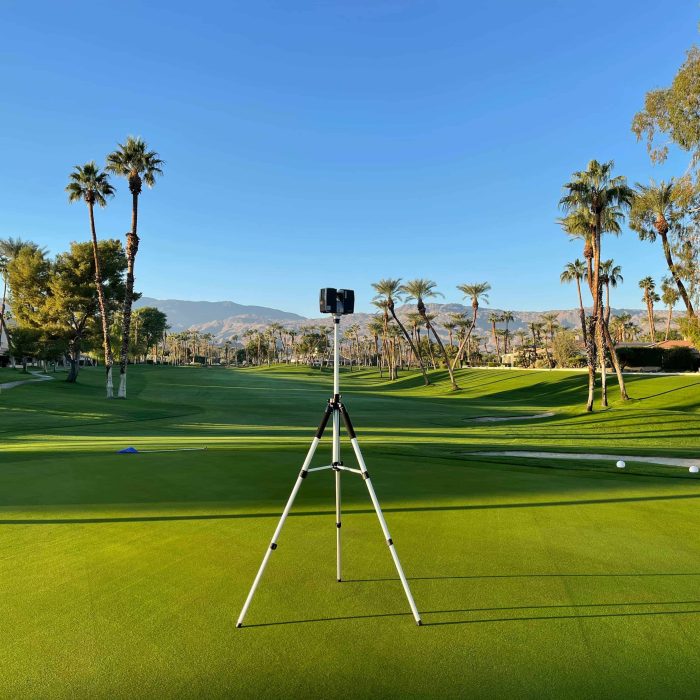
StrackaLine greens start as a laser scan of the putting surface, then print at USGA scale.
What is printed on a USGA greens guide
StrackaLine USGA greens guides show dual-view topographic slope in percent, accurate to the millimeter. A 1-yard / 5-yard grid sits on the green so you can locate your ball and the hole without guessing. Surrounding hazards and sprinkler heads are printed for orientation — they are how you rotate the page until the book matches the ground in front of you.
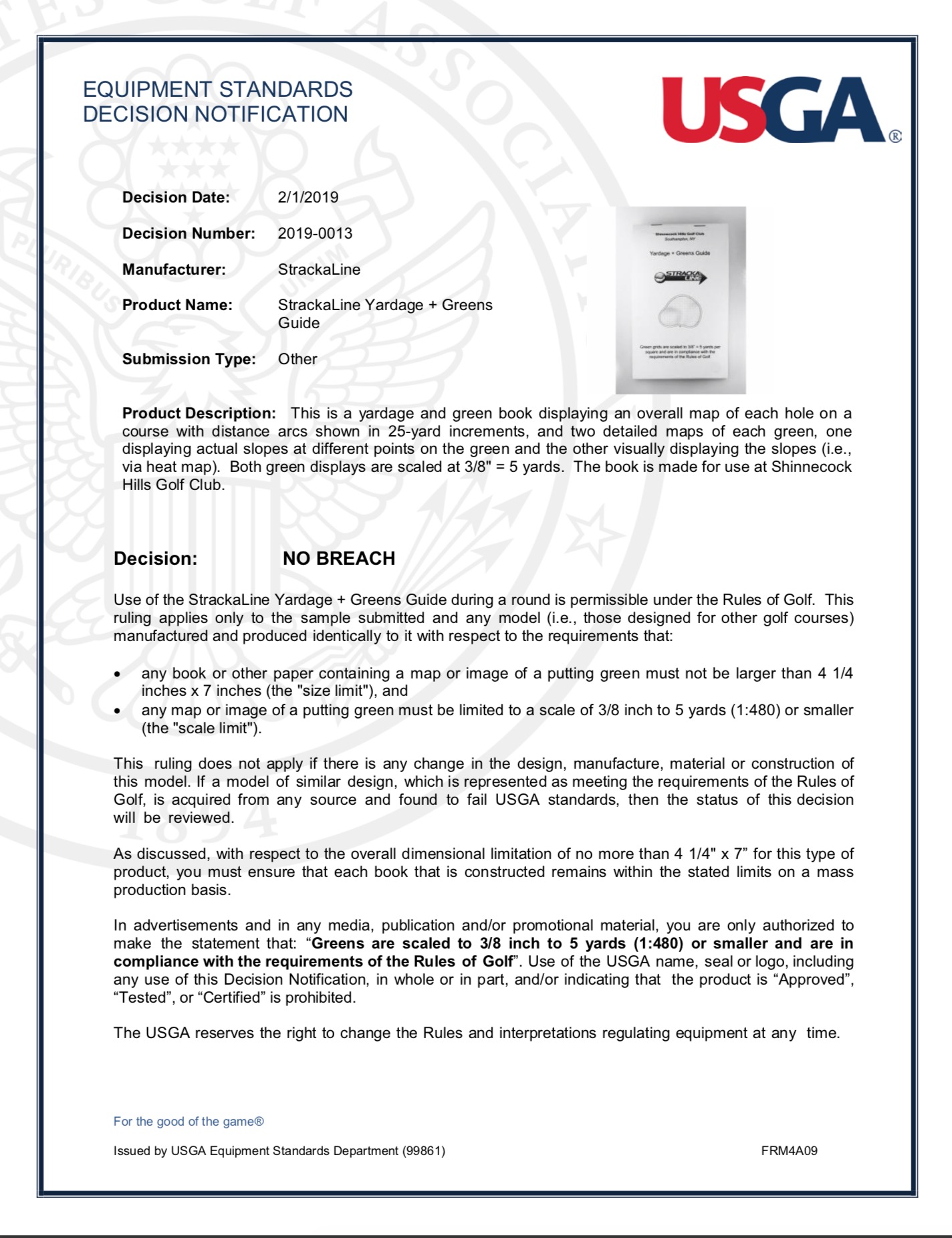
Two numbers control whether that page is legal to use for a line of play on the putting green. The image scale is no larger than 3/8 inch to 5 yards (1:480). The book or paper is no larger than 4 1/4 × 7 inches. StrackaLine currently only offers the USGA legal version. A previous Practice version did not meet the scale limit and is not what ships now. The certification mark we print against those limits is below; the full Rule 4.3 interpretation is on the legal page.
How to use the book on a green
Open the hole you are playing before you reach the green, or as you walk up. Do not wait until you are over the ball with the clock running.
1. Orient the page to the ground
Stand behind the putt — or behind the hole if that is the clearer view — and turn the book until the printed hazards and sprinkler heads match what you see. The grid is useless if the page is rotated the wrong way. The sprinkler heads and bunkers around the green exist on the map so you can lock that orientation before you read a number.
2. Find the ball and the hole on the grid
Use the 1-yard squares to place your ball and the hole. Five-yard marks help you jump across a larger green without counting every square. You are locating two points, not tracing a path the book already chose.
3. Read slope percent between those points
The dual-view topo is slope in percent, not a recommended line of play. Percent tells you how steep the surface is through that area. The fall line is the steepest downhill direction through a point. High ground is the side the contours climb toward; low ground is where they fall. A putt that starts on the high side and finishes on the low side is moving across that change. A putt that stays on one side of a ridge is a different read than a putt that crosses it.
4. Pick an aim, then putt
The book does not choose the aim for you. Rule 4.3 is explicit that a player may not use a device or map to produce a recommended line of play based on the location of the ball. You take the slope you just read, choose a start line, and hit the putt. If you want the color and percent language unpacked further, see How to Read Green Heat Maps.
The same limits apply if you later look at a digital map. You may not zoom a green past 3/8 inch to 5 yards, and the device may not draw a recommended line from ball location. That is why a printed USGA book and a legal digital map are not a free-for-all on the phone. The comparison is on Printed Green Book vs App.
Greens guide, yardage book, or combo
A greens guide is not a yardage book. Yardage books carry tee-to-green measurements, elevation, cover to bunkers and penalty areas, distance rings, and a compass off the tee and to the greens. If you need both in one binding, combo books exist — yardage plus USGA greens. The side-by-side is on Yardage Book vs Green Reading Book.
The course database has 31K+ courses. 13,000+ of those have full hyper-accurate green data. When you search a course, the store options tell you whether green data is available. Walk through the order on How to Order a Yardage Book for Any Course.
Search or buy a book
Checkout lives on StrackaLine.com, not on this site. Search the course and choose greens guide, yardage, or combo there.
Search or buy a course book Watch the how-to video
Pro shops and facilities order through StrackaLine facilities and the existing wholesale book pricing page. College teams use the NCAA program. More guides sit on Resources.
FAQ
Is a StrackaLine greens guide legal in a tournament?
Yes. StrackaLine currently only offers the USGA legal version. Green images are scaled no larger than 3/8 inch to 5 yards, and the book meets the 4 1/4 × 7 inch size limit. Read the Rule 4.3 questions on What’s Legal? – USGA Rules.
Does the book tell me where to aim?
No. It shows dual-view topographic slope in percent and a grid so you can locate the ball and the hole. You pick the aim. A recommended line of play from ball location is not allowed under Rule 4.3.
Where is the video?
The instructional video and signup form are on How to Read a Green Book (video).
What if my course has yardage but no green data?
Search the course at the store. The options on that course tell you which features are available. 31K+ courses sit in the database; 13,000+ have full hyper-accurate green data.